Amateur and professional astronomers create a cosmological masterpiece
posted on: 08-02-2013 source: NASA comments: 0
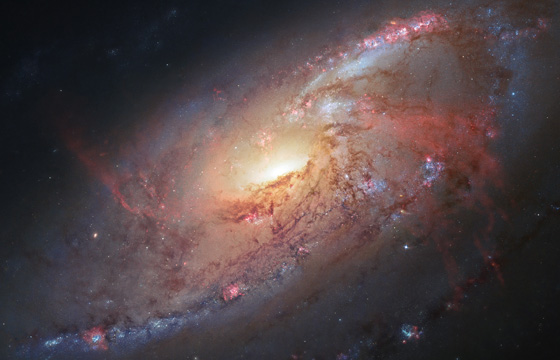
Galaxy M106
Working with astronomical image processors at the Space Telescope Science Institute in Baltimore, Md., renowned astro-photographer Robert Gendler has taken science data from the Hubble Space Telescope (HST) archive and combined it with his own ground-based observations to assemble a photo illustration of the magnificent spiral galaxy M106.
Gendler retrieved archival Hubble images of M106 to assemble a mosaic of the center of the gala... whole story

At least one in six stars has an Earth-sized planet
posted on: 12-01-2013 source: NASA comments: 0
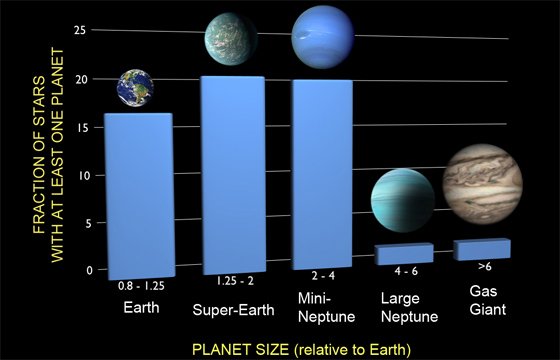
Planet Sizes Relative to Earth
This graph shows the percentages of Earth, Super-Earth, Mini-Neptune, Large Neptune and Gas Giant sized planets orbiting stars we know have at least one planet. The results of a new analysis of Kepler data show that one in six stars has an Earth-sized planet in a tight orbit. About a fourth of all stars in the Milky Way have a super-Earth, and the same fraction have a mini-Neptune. Only about 3 percent of stars have a large Neptune, and... whole story

NASA's NuSTAR catches Black Holes in galaxy web
posted on: 07-01-2013 source: NASA comments: 0
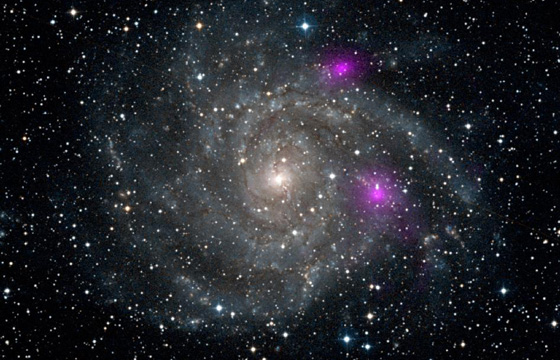
Galaxy IC 342
NASA's Nuclear Spectroscopic Telescope Array, or NuSTAR, set its X-ray eyes on a spiral galaxy and caught the brilliant glow of two black holes lurking inside.
"These new images showcase why NuSTAR is giving us an unprecedented look at the cosmos", said Lou Kaluzienski, NuSTAR program scientist at NASA headquarters in Washington. "With NuSTAR's greater sensitivity and imaging capability, we're getting a wealth of new information on a... whole story

Shot away from its companion, giant star makes waves
posted on: 18-12-2012 source: NASA comments: 0
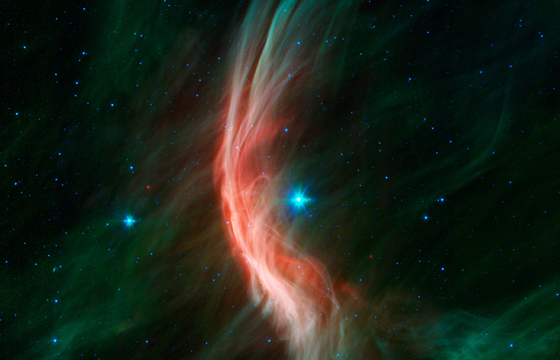
Zeta Ophiuchi
Like a ship plowing through still waters, the giant star Zeta Ophiuchi is speeding through space, making waves in the dust ahead. NASA's Spitzer Space Telescope has captured a dramatic, infrared portrait of these glowing waves, also known as a bow shock.
Astronomers theorize that this star was once sitting pretty next to a companion star even heftier than itself. But when that star died in a fiery explosion, Zeta Ophiuchi was kicked ... whole story

Rocket burn sets stage for dynamic Moon duos lunar impact
posted on: 14-12-2012 source: NASA comments: 0
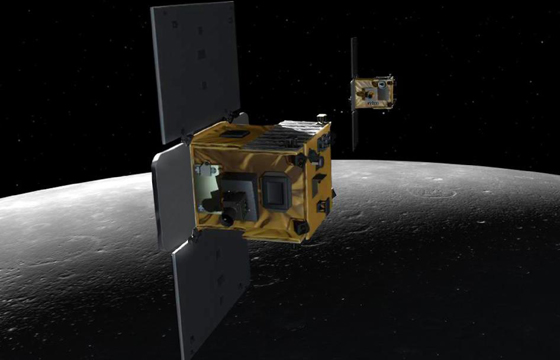
Ebb and Flow
The lunar twins of NASA's Gravity Recovery and Interior Laboratory (GRAIL) mission have each completed a rocket burn that has sealed their fate. The burns modified the orbit of the formation-flying spacecraft. Over the next three days, this new orbit will carry the twins lower and lower over the moon's surface. On Monday afternoon, Dec. 17, at about 2:28 p.m. PST (5:28 p.m. EST), their moon-skimming will conclude when a portion of the l... whole story
feature picture

The Sombrero Galaxy from Hubble

celestial events
October 2026
space programs
Curiosity
learn more at: wiki NASA
James Webb Space Telescope
learn more at: wiki NASA
Kepler Telescope
learn more at: official wiki NASA
Hubble Space Telescope
learn more at: official wiki NASA
International Space Station
learn more at: wiki NASA ESA
Space Shuttle
learn more at: wiki NASA
Apollo 11
learn more at: wiki
Voyager 1-2
learn more at: wiki NASA
Cold War - Space Race
learn more at: wiki
feature video
Da Pro ©2011-2013